« Back to our fieldbook
Bioregioning through our systemic lens
Bioregioning works on every layer of the iceberg at once, but its deepest move happens at the bottom: in how people relate totheir place. And it touches all three of our dots.
Throughout this Fieldbook, we hold every topic up against the same few frameworks: the iceberg, our four system lenses and our three dots. Bioregioning fits them surprisingly well. Maybe because it was systemic long before anyone used that word.
BIOREGIONING THROUGH OUR SYSTEMIC LENS
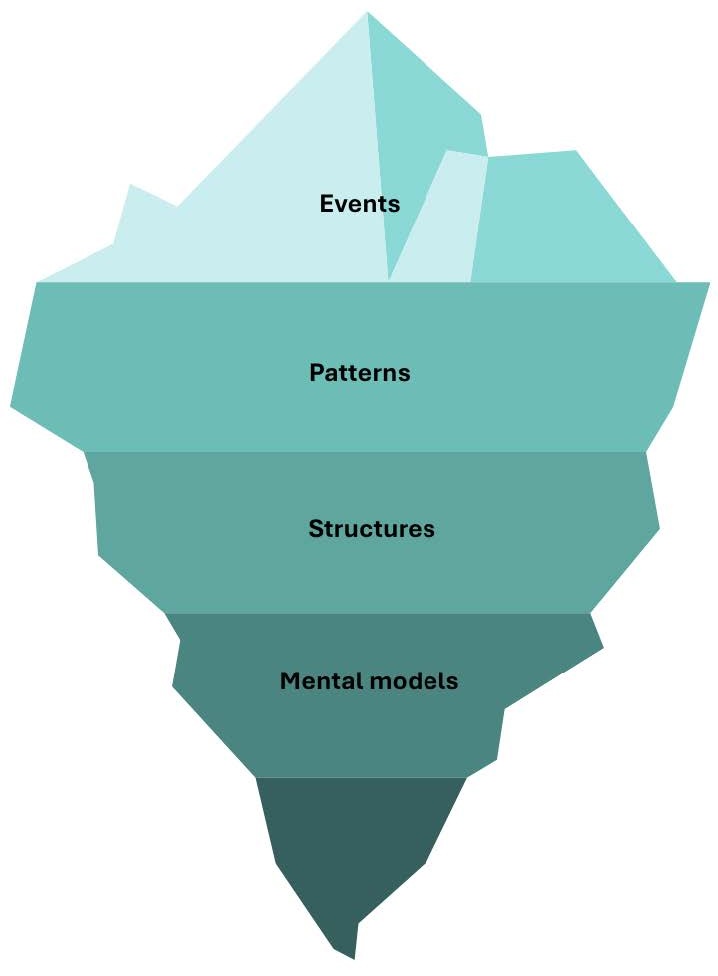
Through the iceberg
|
Level |
What it asks |
In a bioregion |
|
Events |
What do we see happening? |
Floods in the Orne valley in 2025 and 2026. A spring in the Quípar Valley running dry. A farm closing because nobody takes over. |
|
Patterns |
What keeps happening? |
Hedgerows disappearing year after year. Young people leaving, populations ageing. Water quality slowly getting worse. |
|
Structures |
What causes those patterns? |
Subsidies and markets that reward short-term, intensive farming. Administrative borders that cut a watershed into pieces. Finance that is too short-term and too far from the ground. |
|
Mental models |
What holds those structures in place? |
Land as an asset to extract value from. Capital that doesn’t care where it is. People as separate from nature. |
Most interventions start at the top: repair the damage after the flood, fund one more project. Bioregioning works on all fourlevels at once. Local projects deal with events and patterns. New governance (like Quípar’s Territorial Agreement) and new finance facilities change structures. And the Story of Place, together with the old idea of reinhabitation, goes all the way down: to what people believe about where they live, and what they owe it.
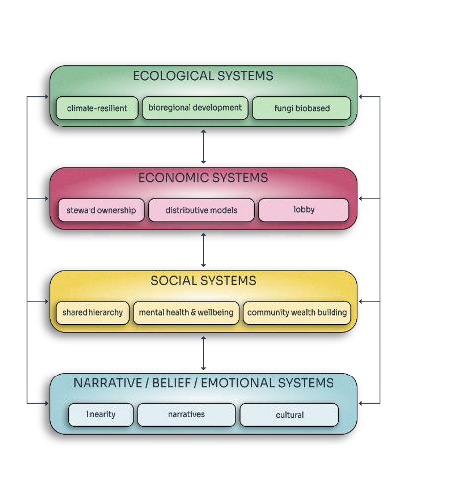
Through the four lenses
In Chapter 1, when we talked about how projects cross our four lenses, we happened to use a valley as our example: “a valley restoration project may simultaneously regenerate ecosystems, strengthen the local economy, and foster social cohesion.” Bioregioning turns that from a happy side effect into the design principle. Here’s what it looks like in two places.
|
Lens |
Quípar Valley (Spain) |
Orne |
|
Ecological |
Restoring soil, water cycles and biodiversity across 30,000 hectares, with La Junquera farm as a living lab |
Replanting hedgerows, protecting water quality and soils along the river |
|
Economic |
Regenerative products, youth entrepreneurship, new land stewardship models |
40+ local businesses, a hedgerow-to-energy cooperative, local supply chains |
|
Social |
A two-year participatory Territorial Agreement, education and farmer training |
A welcome hub that brought 150 new residents, shared spaces, a planned citizens’ committee in its finance facility |
|
Narrative |
From a story of extraction and decline to one of regeneration |
“A shared destiny around water”, from the source of the river to the Channel. |
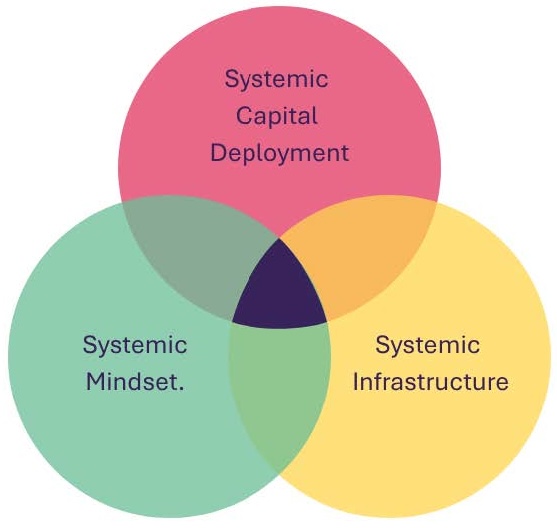
Through our three dots
In Chapter 1, when we talked about how projects cross our four lenses, we happened to use a valley as our example: “a valley restoration project may simultaneously regenerate ecosystems, strengthen the local economy, and foster social cohesion.” Bioregioning turns that from a happy side effect into the design principle. Here’s what it looks like in two places.
Portfolios that turn into flywheels
The authors of Design Foundations for Systems Capital (Hannant et al., 2022) describe the goal of a systemic portfolio as creating a flywheel: a carefully chosen set of investments that stimulate, amplify and sustain larger and more diverse flows of value across the whole system.
The Orne shows what that can look like on the ground. The welcome hub brought young people to the area. They needed a place to work, so a coworking space appeared, and new businesses found each other there. The hedgerow cooperative gave farmers a reason to keep and plant hedges, and gave schools a local source of heat. In the language of Chapter 5, the welcome hub works as an enabler and the hedgerow cooperative as a bridge. Take one away, and the rest would likely struggle more.
That’s why, in a bioregion, it makes little sense to judge each project on its own.