
« Back to our fieldbook
NEXT
Systemic Metrics
Measuring what matters (and what’s hard to measure)
Limits of Traditional Metrics
How do you measure the health of a complex system? This is the kind of question that keeps us up at night.
Counting solar panels installed, jobs created, or MWh saved won’t cut it. Complex systems have non-linear feedback loops, time lags, and intangible shifts that are often lost with traditional KPIs. Sometimes (often), what matters most takes time to show up. In fact, sticking to narrow, short-term metrics will often become a barrier to systemic impact.
That’s why the first lesson in systemic metrics is humility:
acknowledging that what’s easy to measure is not the whole story (and might even be the wrong story!). It’s like trying to measure the quality of a music performance with a decibel meter.
Multi-Dimensional Impact Assessment
New approaches to impact measurement are embracing complexity instead of simplifying it. By looking at multiple levels and dimensions of change.
SSIR’s adaptation of FSG’s “Water of Systems Change” framework describes how change happens on at least three levels:
- structural (policies, resources, practices),
- relational (connections, power dynamics, norms),
- and transformative (mindsets, paradigms).
Instead of asking “Did X improve?”, we ask: How have relationships and power shifted? Are people thinking or behaving differently than before?.
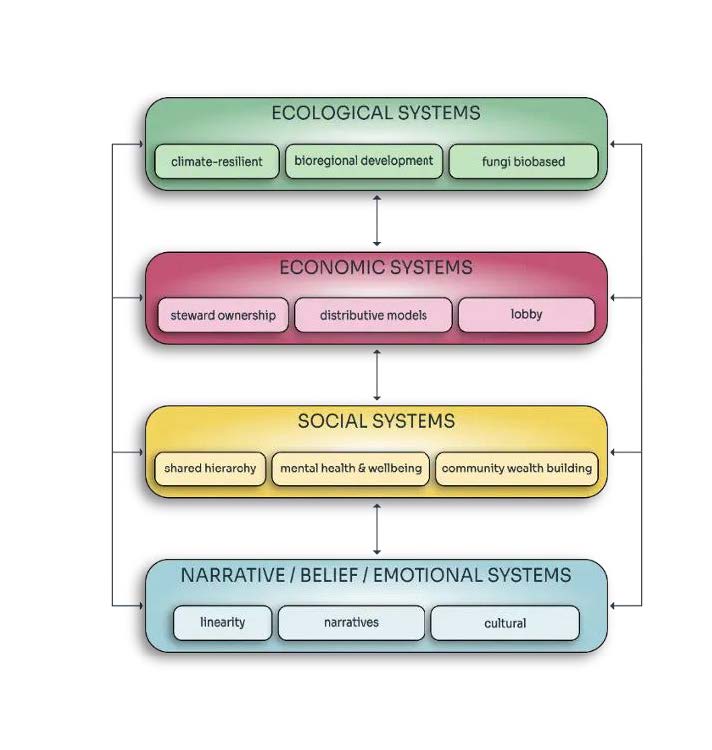
In the Explorers Club, we look at impact through 4 different lenses. This is still far from measuring the actual reality, but that’s part of the big balancing act of learning by doing. You only learn by actually doing. And doing means working within constraints.
Multi-Dimensional Impact Assessment
This layered lens approach captures deeper ripples of change. Crucially, it also values qualitative evidence, not just quantitative data. Stories, experiences, and perspectives often tell us what numbers can’t.
Rockefeller Philanthropy Advisors (RPA) have been one of the clearest voices in the field when it comes to translating systems thinking into actual capital deployment. Their Primer, Playbook, and What’s Next series offers a grounded entry point into multi-dimensional measurement. Moving away from isolated KPIs toward understanding how change actually ripples through a system. Their work can serve as a useful anchor and a reminder that even in complex, hard-to-measure territory, there are frameworks being developed and refined by people genuinely doing the work.
“Hard” data vs “Soft” signals
Systemic impact tracking blends the hard science with the human elements. Yes, we still need solid data (carbon ppm, euros invested, people reached etc.) but we also need to measure things like empowerment, resilience, trust, governance quality…, which are inherently more difficult to quantify.
A sustainable food system might track both soil carbon and farmer collaboration. The first is a number, the second a conversation. Together, they tell the fuller story.
By blending numeric indicators with qualitative insights, you get a more holistic picture of whether a system is shifting.
The art is in combining metrics with meaning
Ensuring our measurements don’t just check boxes but actually inform learning and adaptation in our investment strategy.
Villa Gaia puts it simply as “Collaboration is the metric”.
In a systemic portfolio, the increasing connectivity and trust between previously siloed actors (farmers and insurers, or policymakers
and innovators) is a leading indicator of system health. This contrasts with traditional metrics that might only count “farmers reached” or “policies written.”
The Re:Living Fund illustrates how a purely financial return lens can unintentionally reinforce the very problems it seeks to solve. When retirement capital is optimised solely for yield, it often flows into systems that externalise social costs, including housing and care structures, that ultimately become more fragile and expensive over time. Re:Living explores an alternative: a re-funding strategy that redirects capital into local, human-scale living and care infrastructure.
By doing so, it responds not only to hard metrics like financial sustainability, but also to softer signals such as dignity, resilience and community continuity. The aim is not to sacrifice return, but to align it with the long-term health of the systems retirees themselves will depend on.
Leverage points – Why small moves matter
Not all changes are created equal. A well-placed action at the right point in a system can create disproportionate change.
A key concept in system metrics (and strategy) is identifying those leverage points.
Systemic investors try to look for places where their polycapital can act as a “trim tab” (a small rudder that steers a big ship).
Understanding system structure allows investors to deploy capital in a synergistic way, stack investments, and hitting multiple leverage points so that investments reinforce each other. For instance, investing in EVs and charging infrastructure and policy advocacy reinforces a shift more than any one alone. But that still only looks at the isolated technology of EVs.
It says nothing about transportation as a whole, liveability of cities, mobility of people…
A concrete example of this leverage logic can be found in Leuven 2030’s place-based investment approach. Instead of treating projects as standalone opportunities, they bundle different initiatives into one transition portfolio, combining financially stronger projects with those that are socially or ecologically essential but less commercially attractive.
By capping returns across the portfolio rather than maximising them per project, capital is steered toward system-level outcomes instead of isolated wins. The strength of one intervention helps unlock another, allowing relatively small financial moves to create broader structural shifts within the city’s transition.
From impact to regeneration
Ultimately, systemic metrics shift the focus from simply reducing negative impacts to actively regenerating systems.
In other words, impact is not just “30% less CO₂ emitted” but “we improved the planet’s ability to cycle carbon and support life.”
The concept of regenerative investing aims to restore and enhance the capacity of social-ecological systems to heal and thrive. This goes way beyond doing less harm; it’s about doing more good and leaving systems stronger and more resilient.
Metrics for regeneration might include things like:
- Increase in biodiversity
- Community self-reliance
- Well-being that lasts
Hard to measure? Sure.
But orienting toward these kind of goals moves us from outcome-mapping to scenario-mapping. Towards building the future we want, not just avoiding the dystopia we fear.
By incorporating regenerative indicators into our scorecards, we’re essentially asking:
Are our investments making the system as a whole healthier and more resilient over time?

